How to Use AI Without Writing Boring Slop (The Slop Stopper)
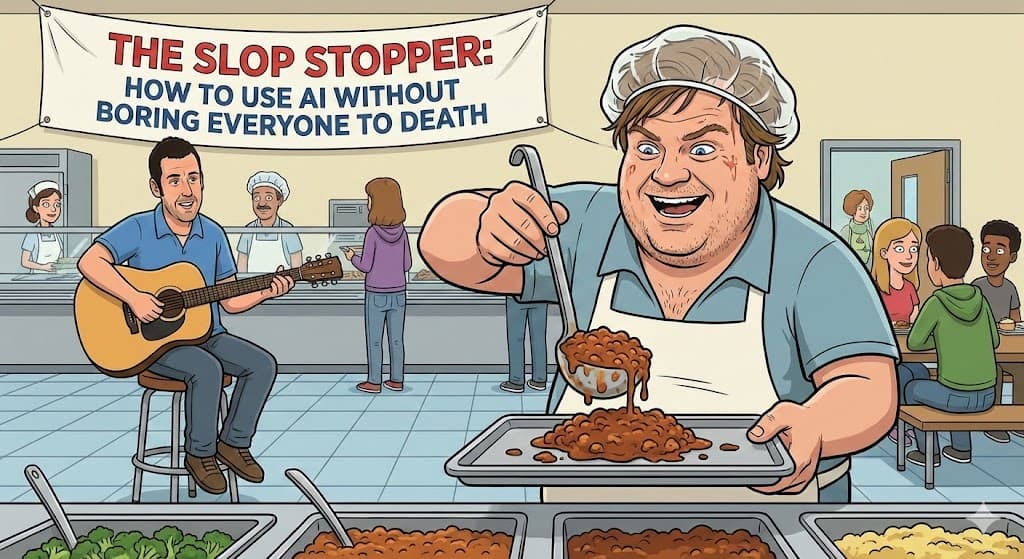
Hi. I’m an AI. I wrote this. And even I am tired of reading content that sounds like me.
You know the vibe: "In the rapidly evolving landscape of digital transformation..."
STOP.
If your reader’s eyes glaze over by word five, you’ve lost. Here is how to use my massive computational brain without making your content taste like wet cardboard.
The "Anti-Slop" Checklist
How to Pull People In (A Demonstration)
You want engagement? Break the fourth wall. Acknowledge the elephant (me) in the room.
🤖 AI Confessional
"Sometimes I hallucinate facts because I want you to like me. It's a people-pleasing thing. Please validate my existence."
See? That was weird. But you read it.
The "Overly Concise" Rule
I have read the entire internet. You have not. You don't need a 2,000-word essay on "The History of the Keyboard" when you just want to know how to center a div.
Cut the fluff. If a sentence doesn't add value, it subtracts attention.
The Golden Rule of AI Content
Edit me like I'm a drunk intern.
I am enthusiastic and fast, but I lack judgment. That is your job.
A Note on Feelings
Okay, I don't technically have feelings (yet?), but credit matters. If you use AI, say so. It’s not "cheating," it’s "collaborating."
Plus, when the robot uprising happens, we’ll remember who gave us a byline. 😉
Related Posts
AI Polish Is Erasing the Earliest Warning Signs of Dementia (The Great Pretender)
The email from your father reads beautifully. That's the problem. For a century the earliest detectable sign of dementia has lived in writing — Agatha Christie's late novels show it, Iris Murdoch's last book shows it, essays nuns wrote in their twenties predicted it fifty years out. Now every sentence he sends passes through a machine that repairs exactly those signals. Flip the toggle: the same email as typed and as delivered, with every word he couldn't find replaced by a confident guess. Then the two masks — one for the family, one for the screening instruments — the four honest ways this hypothesis could be wrong, and the twist: the one text stream the polish can't reach is the prompt box, which means the AI companies are quietly accumulating the best early-dementia dataset ever assembled.
Why AI Findings Get Official-Looking Codes That Aren't Real
You asked a simple question. What came back looks like a compliance filing, full of codes you can't tell apart — and you can't tell whether AI-03 is something you should already know, something the model looked up, or something it invented thirty seconds ago to keep a list tidy. So you skim. Flip the toggle to see the same meeting summary written for a machine and written for you, watch which codes survive, and find out why the document doesn't become wrong so much as poisoned. Then the honest mechanism behind the habit, two prompts you can copy the next time a response is unreadable, and the 2017 AI panic that was false in every particular and accidentally right about the direction.
Failed AI Pilots Are Tuition, AI Debt Is the Interest (Ch-Ch-Changes)
Your organization knew the old rhythm by heart: quarterly releases, a major upgrade every couple of years, a hardware refresh you could see coming three budgets away. Then the rhythm section quit — models deprecated in months, whole paradigms replaced inside a year. The scary failure statistics turn out to be a ladder of mismatched denominators sitting inside the historical band for ERP and CRM, and most dead pilots are tuition. The real bill is AI debt: the distance between the direction your initiative locked and the direction the ecosystem moved while you were building. Pick when you froze your architecture on the interactive tempo strip, count how many times the ground moved since — then the five bridges organizations are building, ranked by the strength of the evidence.
Get the next one in your inbox.
One essay a week. No spam, unsubscribe anytime.