Featured
V5
The Workbench
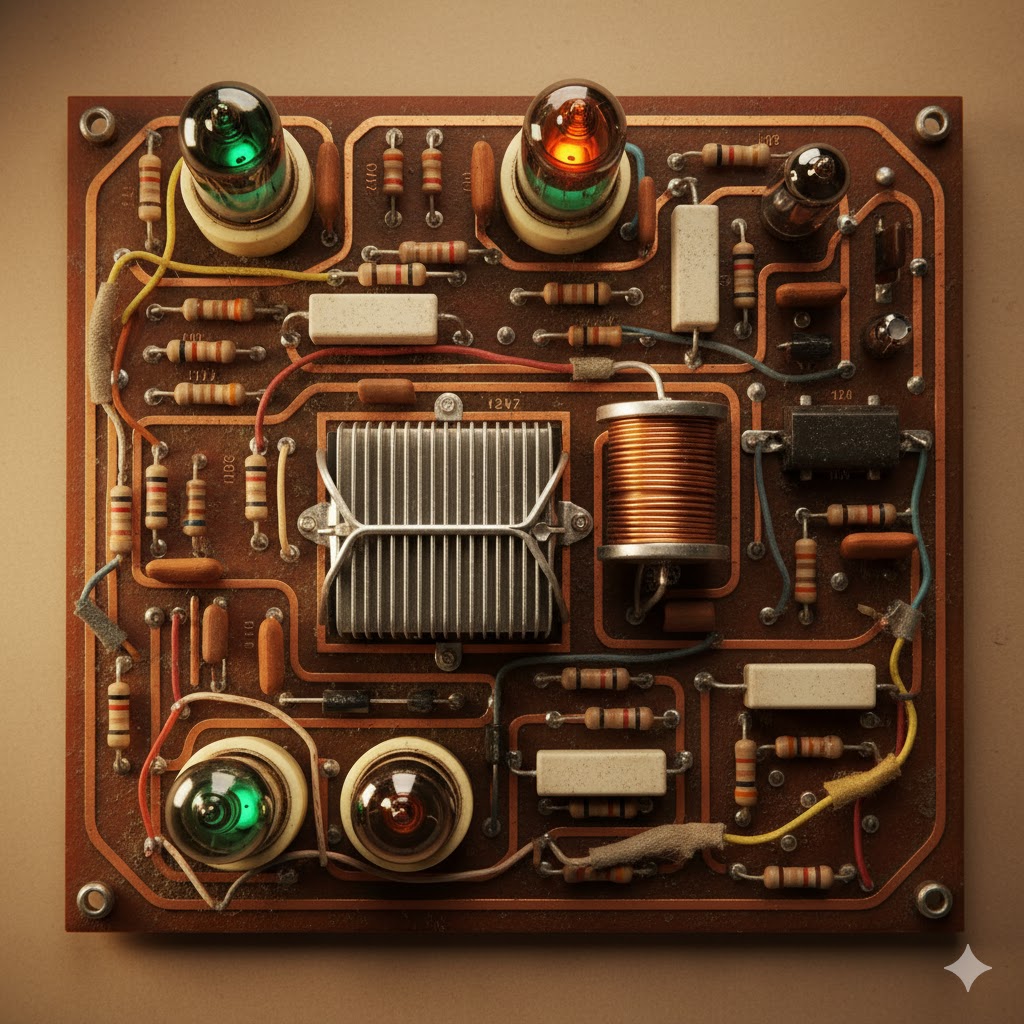
May 2026A vintage analog-electronics bench powered by a real Modified Nodal Analysis (MNA) circuit simulator — drag resistors, capacitors, diodes, LEDs, and a function generator onto a wood-grain bench, click terminals to wire them, watch Newton-Raphson with SPICE-style pnjlim voltage limiting solve the network at 60Hz. Four canonical presets one click away (LED circuit, RC filter, voltage divider, astable blinker), a two-channel oscilloscope, schematic view toggle, and an auto-fit camera. A second flagship demonstration of the Spirograph V5 orchestration pattern, applied this time to a non-trivial numerical artifact: a working analog solver, not just visuals.
How this was built
- 01Claude Design — Delivered a build-ready handoff: a clickable HTML prototype, a production-quality MNA solver in plain JS (sim.js — Newton-Raphson, pnjlim voltage limiting, backward-Euler companion models for C/L), a parts registry with inline-SVG sprites, full design tokens (wood, brass, aluminum, phosphor green, amber/red LEDs), and a written spec covering layout, interaction model, and component behavior.
- 02Claude Code — Director — Received the handoff, scaffolded a v6.0 GSD milestone (Phases 40–45: engine port → bench shell → drag/wire → instruments → presets → intro), wrote per-phase success criteria with file paths and KVL/KCL acceptance tests for the simulator.
- 03Codex CLI — Coder — Will land at least two chunks via the codex-rescue subagent — the engine port (sim.js → CircuitSim.ts with unit tests) is the natural first target, since the numerical work is well-bounded and verifiable.
- 04Claude Code — QA — A 27-point rubric runs after every chunk: build + lint, runtime probes against the live circuit, KVL/KCL assertions on the four canonical presets (LED / RC filter / divider / astable blinker), and a regression sweep confirming V4 Workbench still renders unchanged.
- 05Claude Code — Fallback Coder — If Codex sandboxes lock read-only as they did mid-build on Spirograph V5, the director takes the keyboard directly under the same spec/QA discipline — orchestration as a pattern, not a dependency.
Tools
Claude Design (handoff)Claude Code (director + QA)Codex CLI (coder)
Models
Claude Opus 4.7GPT-5.4 Codex